
Hapo BACK
ErgoSanté · France
Spring-rod back exoskeleton for forward bending, 1.1 kg and battery-free, with a release for sitting down.

Hapo BACK is a passive back exoskeleton made in France by ErgoSanté under its Hapo brand. Two composite spring rods run from frames in the shoulder straps past a lumbar belt to sleeves on the thighs; when the wearer leans forward, the rods bend and pass part of the upper-body load to the thighs. A locking ring at each hip switches the assistance off for sitting down or using stairs.
- Weight (maker's figure)
- 1.1 kg
- Less muscle effort (maker)
- About 20%
- To put on (maker's figure)
- < 50 s
- Use range, dry conditions
- −10 to +40 °C
- Model
- Hapo.2
- Written from
- hapo.eu
- Information as of
- Local partner
- Not in public info
At a glance
Reduces
Lower-back fatigue from prolonged or repeated forward bending and carrying loads
Suitable for
Tasks with repeated or sustained partial forward bending of the trunk (0–90°), with or without a load, including jobs that alternate bending with sitting. The maker names logistics, construction, industry, vine pruning and surgery.
Not suitable for
Outside −10 to +40 °C or outside a dry environment; explosive atmospheres, chemical splashes or exposure to abrasive material (maker's conditions of use). Deep bends beyond 90°, kneeling and squatting are listed for the Hapo SD instead. Work with a fall risk, such as on roofs, or with sharp tools needs prior approval from a health and safety officer. Not for use during pregnancy.
The maker's warnings (16)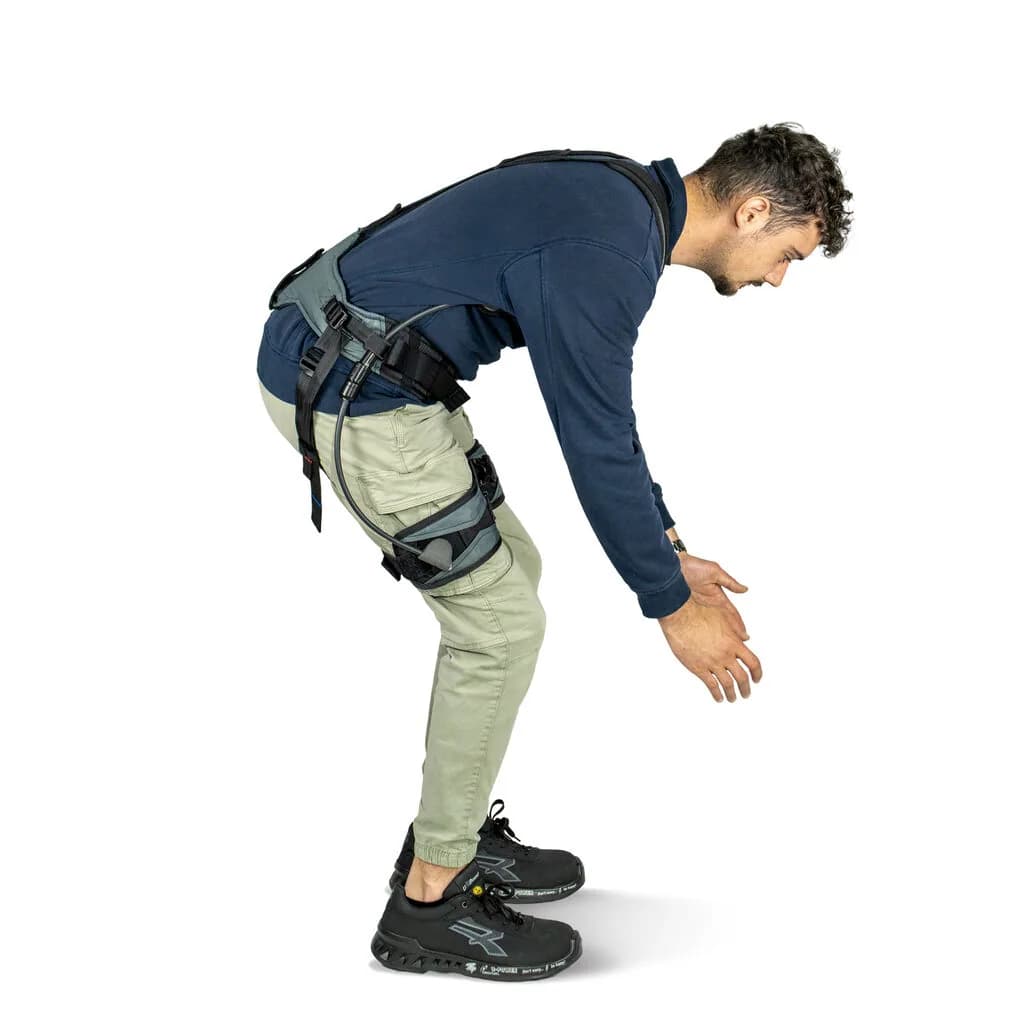
01 · How it works
Two spring rods that hand part of the load to the thighs
The manual describes a partial transfer of effort from the upper trunk, through support at the chest, to the thighs, with the lumbar belt holding the rods at the hips.
Each rod is fixed at three points: at the top to a frame inside the shoulder strap, at the bottom to a sleeve on the thigh, and in the middle to the side of the lumbar belt by a pre-tension strap with red ends. The wearer feels the assistance when leaning forward while bending the knees: the rods bend and take part of the trunk's load, spreading it to the thighs and the chest. The middle fixing holds a release mechanism. Sliding its locking ring down until it clicks engages the rod; pulling it up to the stop frees the rod, for example to sit down.
- Intended for partial bends of the trunk, 0–90°, with or without a load
- Assistance off for sitting down and before using stairs
- No motor and no battery, so nothing to charge
- Spring pre-tension is set with the red straps at the hips
02 · The 20% figure
What the 'about 20% less effort' figure rests on
The product page links a 2022 study of the 2022 version of Hapo by three ErgoSanté researchers, posted as a preprint without peer review.
14 staff members, two tasks
Fourteen ErgoSanté employees not involved in exoskeleton design (6 women, 8 men) worked with and without it: lifting and lowering a 6 kg box ten times, and holding a forward bend of about 40° for one minute.
About 18% less back-muscle activity
Surface EMG, normalised to each person's maximum contraction, showed the back extensor studied (erector spinae, longissimus) about 18% less active in both tasks. The product page rounds this to about 20%.
Less back discomfort reported
On the 0–10 Borg CR10 scale, discomfort in the thoracolumbar area fell from 3.5 to 2.2 when lifting and from 3.5 to 1.9 when holding the bend. Balance, measured on a force plate, did not change significantly.
Side effects and limits
An abdominal muscle, the external oblique, worked 28.6% harder during lifting. The authors note a small, young and healthy in-house sample, short tasks, and their own link to the maker.
03 · Hapo range
Where BACK sits among Hapo's back models
Hapo sells five back-support models. Uses and assistance levels come from its January 2026 range guide and product pages; prices are from hapo.eu, excluding VAT, on 2026-10-11.
Hapo BACK
- Intended use (maker)
- Partial bends of 0–90°, with or without a load; can be switched off to sit
- Assistance (maker)
- About 20% less muscle effort
- Sizes
- S1–S3: 1.60 m to over 1.95 m
- Price excl. VAT
- EUR 1,999
Hapo SD
- Intended use (maker)
- Deep bends beyond 90°, kneeling on one knee and squatting; cannot be switched off
- Assistance (maker)
- 15% (Standard) or 20% (Hard)
- Sizes
- S0–S3: 1.50 m to over 2.00 m
- Price excl. VAT
- EUR 1,799
Hapo CS
- Intended use (maker)
- Vest-type harness; the range guide says it suits female and male body types
- Assistance (maker)
- 15%
- Sizes
- S1–S3: 1.50–1.95 m, plus harness sizes
- Price excl. VAT
- EUR 1,799
Hapo BR
- Intended use (maker)
- Vertical traction that decompresses the spine; standing or seated postures
- Assistance (maker)
- Not given as a percentage
- Sizes
- One frame size; 3 upper and 3 lower belt sizes
- Price excl. VAT
- EUR 2,996 (out of stock)
Hapo HD
- Intended use (maker)
- 'Heavy duty': spring blades in a back casing, for dusty, demanding sites
- Assistance (maker)
- Not given as a percentage
- Sizes
- One size: 1.55–1.95 m
- Price excl. VAT
- EUR 1,069
Hapo also makes FRONT (arms in front of the body; Hapo MS appears to be its earlier name), UP (overhead work) and NECK (head-up postures). Hapo's US shop lists BACK at USD 2,822.
04 · Specifications
Hapo BACK specifications
From the maker's datasheet (05/2026), the instruction manual for Hapo BACK and SD (V.07.25) and the product page.
Build and assistance
- Type
- Passive: two composite spring rods, no motor
- Load path
- Part of the upper trunk's effort goes through a chest support and the lumbar belt to the thighs
- Muscle effort
- About 20% less (maker's figure; about 18% measured in its 2022 in-house study)
- Switch-off
- Release mechanism with a locking ring at each hip; a click confirms it is engaged
- Weight
- 1.1 kg
- Power
- None: no battery, no charging
- Noise
- 0 dB (manual)
- Colours
- Black or white
Sizes and fit
- Sizes (user height)
- S1: 1.60–1.75 m; S2: 1.75–1.95 m; S3: over 1.95 m
- Between sizes
- At 1.75 m, S1 or S2; at 1.95 m, S2 or S3 (size guide)
- Dimensions
- Length 92 / 94 / 103 cm (S1 / S2 / S3), width 40 cm, height 25 cm, each ±2 cm
- Adjustment range
- Belt 68–140 cm; thigh sleeve 40–55 cm; back strap 19 cm of travel
- Putting on / taking off
- Under 50 s / about 20 s (maker's figures)
Use and care
- Conditions of use
- −10 to +40 °C, dry environment
- Not allowed
- Explosive atmospheres, chemical splashes, exposure to abrasive material
- Users
- One trained adult aged 18–64; professional use only
- Wearing time
- Up to 8 h a day
- Service life
- 5 years with the maintenance in the manual
- Fabric
- Breathable, water-repellent, washable
- Washing
- Textiles come off for washing: machine at 40 °C with a 600 rpm spin (French manual; the English one says 140 °F), or by hand; no bleach, ironing, solvents or fabric softener; line-dry
- Daily check
- The spring covers have braided, yellow and red layers; stop and replace the springs if red shows
- Storage
- Indoors and dry, on the supplied hanger
Compliance and support
- CE marking
- Machinery Directive 2006/42/EC, for sales in Europe (manual)
- Declaration of conformity
- Not found on the maker's sites or in its media library (2026-10-11)
- Quality system
- ErgoSanté is certified to ISO 9001:2015
- Warranty
- 2 years after online registration: spring breakage, mechanical parts and textile manufacturing defects
- Spare parts
- Textile, spring and spring-protector kits by size, with part numbers in the manual
- Made in
- France (Gard), according to the maker
05 · Cautions
Where it must not be used, and how to use it safely
From the maker's instruction manual for Hapo BACK and SD (V.07.25) and the BACK datasheet. The quotes are the maker's own words.
Our summary, then the maker's own words
Use it only between −10 °C and +40 °C, in a dry environment.
In the maker's words:
-10°C to +40°C (14°F to 104°F) / Dry environment
ergosante.kontainer.comNot allowed in explosive atmospheres, where chemicals may splash, or where it is exposed to abrasive material.
In the maker's words:
Explosive environments, chemical splashes or exposure to abrasive elements.
ergosante.kontainer.comThe manual lists partial bends of the trunk, up to 90°, as the BACK's use; deeper bends are listed under the Hapo SD.
In the maker's words:
Partial flexion (between 0° and 90°)
ergosante.kontainer.comBefore work, check that each locking ring clicks into place; without the click the assistance may suddenly give way.
In the maker's words:
If there is no click, the mechanism is likely not engaged and there is a risk of sudden loss of assistance.
ergosante.kontainer.comSwitch the assistance off before going up or down stairs, to avoid losing balance.
In the maker's words:
Do not go up or down stairs without deactivating the assistance (risk of loss of balance).
ergosante.kontainer.comWork where a fall is possible, such as on roofs, requires prior approval from a health and safety officer.
In the maker's words:
It is forbidden to use the Hapo BACK or the Hapo SD in situations where there is a risk of falling (work on the roof, etc.) without having obtained prior approval from a health and safety officer.
ergosante.kontainer.comHandling sharp tools while wearing it also requires prior approval from a health and safety officer.
In the maker's words:
It is forbidden to use the Hapo BACK or the Hapo SD while handling sharp tools without having obtained prior approval from a health and safety officer.
ergosante.kontainer.comCheck the springs before each use: if the red inner layer shows through the cover, stop and replace the spring assembly.
In the maker's words:
If you see the red sheath, stop using the Hapo BACK or the Hapo SD immediately and replace the spring assembly.
ergosante.kontainer.comKeep it away from flames, embers and other heat sources; the manual warns the textile can melt.
In the maker's words:
near flames, embers or other heat sources that could damage it.
ergosante.kontainer.comWear it over clothing, not under it.
In the maker's words:
Do not use the Hapo BACK or the Hapo SD under clothing.
ergosante.kontainer.comIntended for one adult aged 18–64, for professional use. Before another person uses it, it must be cleaned, and that person trained and the unit adjusted by specialist staff.
In the maker's words:
The Hapo BACK and Hapo SD are intended to be used by a single adult user between the ages of 18 and 64.
ergosante.kontainer.comWear it for no more than 8 hours a day.
In the maker's words:
Maximum 8h/day
ergosante.kontainer.comNot to be used during pregnancy; people with back, leg or knee problems should get medical advice first.
In the maker's words:
Do not use Hapo BACK or the Hapo SD if you are pregnant
ergosante.kontainer.comThe manual says not to use it to lift a person.
In the maker's words:
Do not use the product to lift a person.
ergosante.kontainer.comClean it straight away after contact with salt water, chlorine or abrasive substances such as sand.
In the maker's words:
Clean the product immediately if it comes into contact with salt water, chlorine or abrasive substances (such as sand).
ergosante.kontainer.comIt does not replace PPE, and the maker says it does not exempt users from the French manual-handling standard NF X35-109.
In the maker's words:
The use of Hapo BACK or the Hapo SD does not exempt you from wearing PPE.
ergosante.kontainer.com
06 · FAQ
Buying, training and after-sales, from Hapo's FAQ
Rewritten from Hapo's FAQ and warranty pages. Advisers and on-site services are organised for France; nothing here is specific to Japan.
Do wearers need training?
Yes. Hapo gives a short practical session when the exoskeleton is set up, covering how to adjust it and how to fit it into daily work.
From the maker's siteCan we test or rent one before buying?
Hapo's experts analyse the task, propose trials in real working conditions and recommend a model. Rental is also offered through an adviser; the terms are not published.
From the maker's siteHow is it bought, and what does the range cost?
Orders can be placed on hapo.eu; a local Hapo adviser then handles them according to the delivery address. Across the range, prices run from EUR 534 to EUR 3,500, excluding delivery and training by a consultant.
From the maker's siteHow does the warranty start?
The 24-month warranty is activated by registering online with the invoice and the four-digit serial number from the label. Without registration, the start date is ErgoSanté's original invoice to its retailer.
From the maker's siteWhat happens if a part fails?
Hapo has an online after-sales request form and says it keeps spare parts in stock, so requests can be handled quickly.
From the maker's siteWhere is it made?
Hapo says it designs and makes its exoskeletons in its own workshop in the Gard, in southern France.
From the maker's site07 · Videos
Fitting, washing and a day in a warehouse
Official videos from Hapo's YouTube channel. The fitting and textile videos are in English; the forklift operator's story is in French.
HAPO BACK | How to put on and adjust the exoskeleton
HAPO · 5:09 · English
Plays from YouTube once started. Open on YouTube
How to remove and reinstall the HAPO BACK textiles
HAPO · 6:38 · English
Plays from YouTube once started. Open on YouTube
8 tonnes a day: the HAPO exoskeleton that changes a forklift operator's daily work
HAPO · 1:35 · French
Plays from YouTube once started. Open on YouTube
08 · Sheet
Side by side, on the same sheet.
Every product in the catalog is described with the same fields, in the same order, so you can compare them side by side. What it reduces and where it fits are at the top of this page.
- Key specs
- Passive exoskeleton: two composite spring rods run from frames in the shoulder straps past the lumbar belt to thigh sleeves and pass part of the trunk's load to the thighs. A locking ring at each hip switches the assistance off. 1.1 kg, no battery. Sizes S1–S3 for users 1.60 m to over 1.95 m tall; belt 68–140 cm. On in under 50 s, off in about 20 s. Breathable, water-repellent, washable textiles. Use at −10 to +40 °C in dry conditions, up to 8 h a day. About 20% less muscle effort (maker's figure).
- Price conditions
- Not published for Japan. The maker's EU online shop (hapo.eu, professional buyers only) lists it at EUR 1,999 excluding VAT (EUR 2,398.80 with 20% VAT), and its US shop (hapo.us) at USD 2,822, both before shipping (2026-10-11).
- Trial
- Not in public info
- Lead time
- Not in public info
- Service and repair
- 2-year warranty once registered online, covering spring breakage, mechanical parts and manufacturing defects in the textiles; the maker either sends replacement parts with fitting instructions or replaces them on site (maker's EU terms). Spare textiles, springs and spring protectors are sold as kits.
- Local partner
- Not in public info
- StandardsMaker's declaration
- CE marking under the Machinery Directive 2006/42/EC, which the manual states is for sales in Europe. ErgoSanté is certified to ISO 9001:2015. The maker also cites a 'Made in France' recognition by French customs and an EcoVadis 'Committed Company' label.
09 · Documents
Documents and links.
Official files and pages from ErgoSanté. Each opens on the maker's site.
- Hapo BACK technical datasheet (05/2026)Datasheet · English · PDF
- Instruction manual, Hapo BACK and SD (V.07.25)User manual · English · PDF
- Instruction manual in French (V.07.25)User manual · French · PDF
- Simplified instructions in picturesGuide · Several languages · PDF
- Study: effects of a passive back exoskeleton (2022 preprint)Document · English · PDF
- Hapo BACK product pageWeb page · English · hapo.eu
- Warranty registrationWeb page · English · hapo.eu
- Terms and conditions of sale (23/07/2026)Web page · English · hapo.eu
10 · Maker
ErgoSanté
France
ErgoSanté was founded in 2013 in Anduze, in the Cévennes, and designs, makes and distributes ergonomic equipment for workplaces, with an original focus on keeping people with disabilities in work. Its Hapo brand has made non-motorised exoskeletons since 2016, and Hapo says production runs in France and the United States.
- Founded
- 2013
- Headquarters
- Anduze (Gard), France
- Website
- hapo.eu
Sources34
Read on . Each date below is the version we read: an archived copy's capture date, or a document's own date.
- Hapo BACK product page (hapo.eu, English)hapo.eu ·
- Hapo BACK product page (hapo.eu, French)hapo.eu ·
- Hapo BACK technical datasheet, English (05/2026)ergosante.kontainer.com ·
- Hapo BACK technical datasheet, French (07/2025)ergosante.kontainer.com ·
- Instruction manual Hapo BACK & Hapo SD, English (V.07.25, 09/2025)ergosante.kontainer.com ·
- Notice d'instruction HAPO BACK et HAPO SD, French (V.07.25)ergosante.kontainer.com ·
- Hapo BACK simplified instructions, multilingual (version A5, 29 April 2025)ergosante.kontainer.com ·
- Albouy, Lebel, Le Tellier: Effects of a passive back assistance exoskeleton for load carrying and trunk bending tasks (study PDF linked from the product page)hapo.eu ·
- Same study, French version (linked from the French product page)hapo.eu ·
- Research Square preprint record for the study (posted 9 December 2022)researchsquare.com ·
- Hapo FAQhapo.eu ·
- Hapo warranty statement (registration page)hapo.eu ·
- Hapo general terms and conditions of sale (version dated 23/07/2026)hapo.eu ·
- hapo.eu legal noticeshapo.eu ·
- Expertise Hapo (About us)hapo.eu ·
- Hapo SD product pagehapo.eu ·
- Hapo SD technical datasheet, English (05/2026)ergosante.kontainer.com ·
- Hapo CS product pagehapo.eu ·
- Hapo BR product pagehapo.eu ·
- Hapo HD product pagehapo.eu ·
- Hapo HD technical datasheet, Englishergosante.cdn.kontainer.com ·
- Hapo FRONT product pagehapo.eu ·
- Hapo BACK product page on the US shop (hapo.us)hapo.us ·
- hapo.us legal notices and terms of sale (version dated 1/01/2024)hapo.us ·
- Hapo media library (Kontainer), linked as 'Resources' from hapo.eu: HAPO PHOTO › HAPO BACK and IMAGES PNG foldersergosante.kontainer.com ·
- Hapo exoskeleton range guide, UK (01/2026), in the media libraryergosante.kontainer.com ·
- Hapo Exoskeleton Cleaning Guide (23/04/2025), in the media libraryergosante.kontainer.com ·
- ErgoSanté home page (agency network and 'Autres zones')ergosante.fr ·
- ErgoSanté: Qui sommes-nousergosante.fr ·
- YouTube: HAPO BACK | How to put on and adjust the exoskeletonyoutube.com ·
- YouTube: How to remove and reinstall the HAPO BACK textilesyoutube.com ·
- YouTube: 8 Tonnes par Jour : L' Exosquelette HAPO qui Transforme le Quotidien d'un Caristeyoutube.com ·
- HAPO YouTube channel, videos tabyoutube.com ·
- Exoskeleton Report: Hapo FRONT, 'formerly HAPO-MS' (third party, corroboration only)exoskeletonreport.com ·
We wrote this page from ErgoSanté's public website and documents as of . ErgoSanté has not confirmed anything on it and is not involved with this site. Photos and videos are ErgoSanté's own, each linked to where it appears. Items the maker does not publish are marked “Not in public info”. Standards are the maker's declarations; we do not judge compliance.
Other products on the same sheet

BionicBack
hTRIUS · Germany
A passive back exoskeleton with a flexible, spine-shaped frame and two support settings, made in Germany.

Custom Fit Kneepads
ProKnee · United States
Full-length kneepads that move kneeling weight onto the shins, sized to each worker's leg measurements.

SoftExo Lift
HUNIC · Germany
Passive textile exoskeleton: leg elastomers store energy as you bend and give it back as you straighten up.