
BionicBack
hTRIUS · Germany
A passive back exoskeleton with a flexible, spine-shaped frame and two support settings, made in Germany.

BionicBack is worn like a backpack. Flexible plastic strips shaped like a spine run down the back, and elastic elements over the buttocks connect the hip shells to cuffs on the thighs. A strap on the right sets dynamic support for repeated bending and lifting and one on the left adds static support for holding bent-over postures; there is no motor or battery, and it weighs about 1.18 kg (maker's figures).
- Weight (approx., ±200 g)
- 1.18 kg
- Sizes by body height
- XS / M / XL
- Permitted ambient temperature
- 0–40 °C
- Dynamic and static support
- 2 settings
- Written from
- htrius.com
- Information as of
- Local partner
- Not in public info
At a glance
Reduces
Lower-back strain from repeated bending and lifting and from long bent-over work
Suitable for
Work with frequent bending and lifting between floor and hip height, and long bent-over tasks. The maker names logistics and order picking, beverage and furniture transport, construction (paving, road and civil works), landscaping, tiling, car workshops, retail and event crews; static support for care work, gardening and assembly stations.
Not suitable for
Per the manual: not for lifting loads the wearer could not lift without it; not a fall-arrest or climbing harness (the maker lists the standard model as not compatible with fall protection; its FP READY variant is meant for that); support must be off on ladders and scaffold stairs; use only at 0 to 40 °C, protected from heavy rain and long direct sun; near exposed moving machinery only with strap ends stowed; people with musculoskeletal conditions should consult a doctor first.
The maker's warnings (12)
01 · How it works
A spine-shaped frame and elastic 'muscles'
The back panel is a set of flexible plastic strips shaped like a spine. It sits close against the lower back, helps keep it straighter and spreads the forces that arise in lifting across the whole system. Elastic elements in fabric sleeves run over the buttocks to the thigh cuffs; when the wearer bends forward they stretch and store energy, which reduces muscle work during the movement (maker's description).
- Twisting, bending and squatting stay possible; the strips add a slight spring effect
- Forces are transmitted through a rope in guide tubes; the maker's freewheel function is meant to let wearers walk and move normally
- Few contact areas and mesh shoulder straps to limit heat build-up
- No motor, battery or electronics, so nothing to charge
02 · Two settings
Dynamic and static support side by side
The standard BionicBack has both settings. They work alone or together and can be changed at any time by opening the buckle.
Set with
- Dynamic support
- Coloured strap on the right hip shell, then close the buckle
- Static support
- Coloured strap on the left hip shell (marked 'static' or 'Booster')
Adjustment
- Dynamic support
- Continuous; the closer the fabric over the buttocks sits, the more support
- Static support
- The further the strap is pulled, the earlier in the bend it engages
What it does
- Dynamic support
- Assists every bend and lift, all shift long
- Static support
- Engages from a set bending angle with a damping effect and stiffens the back structure; the wearer can almost lean into it
Maker's example tasks
- Dynamic support
- Frequent, quick bending and lifting: beverage and furniture logistics, freight forwarding
- Static support
- Long bent-over work: care work, landscape gardening, assembly stations, leaning over edges
Notes
- Dynamic support
- For frequent deep bending and straightening, it may be enough on its own
- Static support
- Set strongly, it can stop the wearer bending deeply or lifting from the floor; set it weaker or open the buckle
Ladders and scaffold stairs
- Dynamic support
- Switch off before climbing
- Static support
- Switch off before climbing
From the maker's product page, online how-to and manual. The BionicBack MOVE and FP READY variants have dynamic support only.
03 · Putting it on
Putting it on and setting the support
Condensed from the 15 steps in the maker's manual and its online how-to. Wearers put it on and adjust it themselves, and settings can be changed at any time.
- 01
Open everything first
Open the buckles on both hip shells and all click buckles, lengthen the shoulder straps and free the retaining straps from the Velcro on the leg shells.
- 02
Put it on like a backpack
Slip both arms into the shoulder straps so the system sits centred on the back. Close the waist belt at about navel height; it can stay fairly loose.
- 03
Adjust the chest and shoulder straps
Where fitted, set the chest strap about 5 cm below the collarbone. Shorten the shoulder straps until the curve of the back structure sits at the lower back, without restricting the arms.
- 04
Fasten the thigh supports
Close each leg support midway between hip and knee, then wrap the retaining strap round the thigh and fix it to the leg shell with Velcro. Repeat on the other leg.
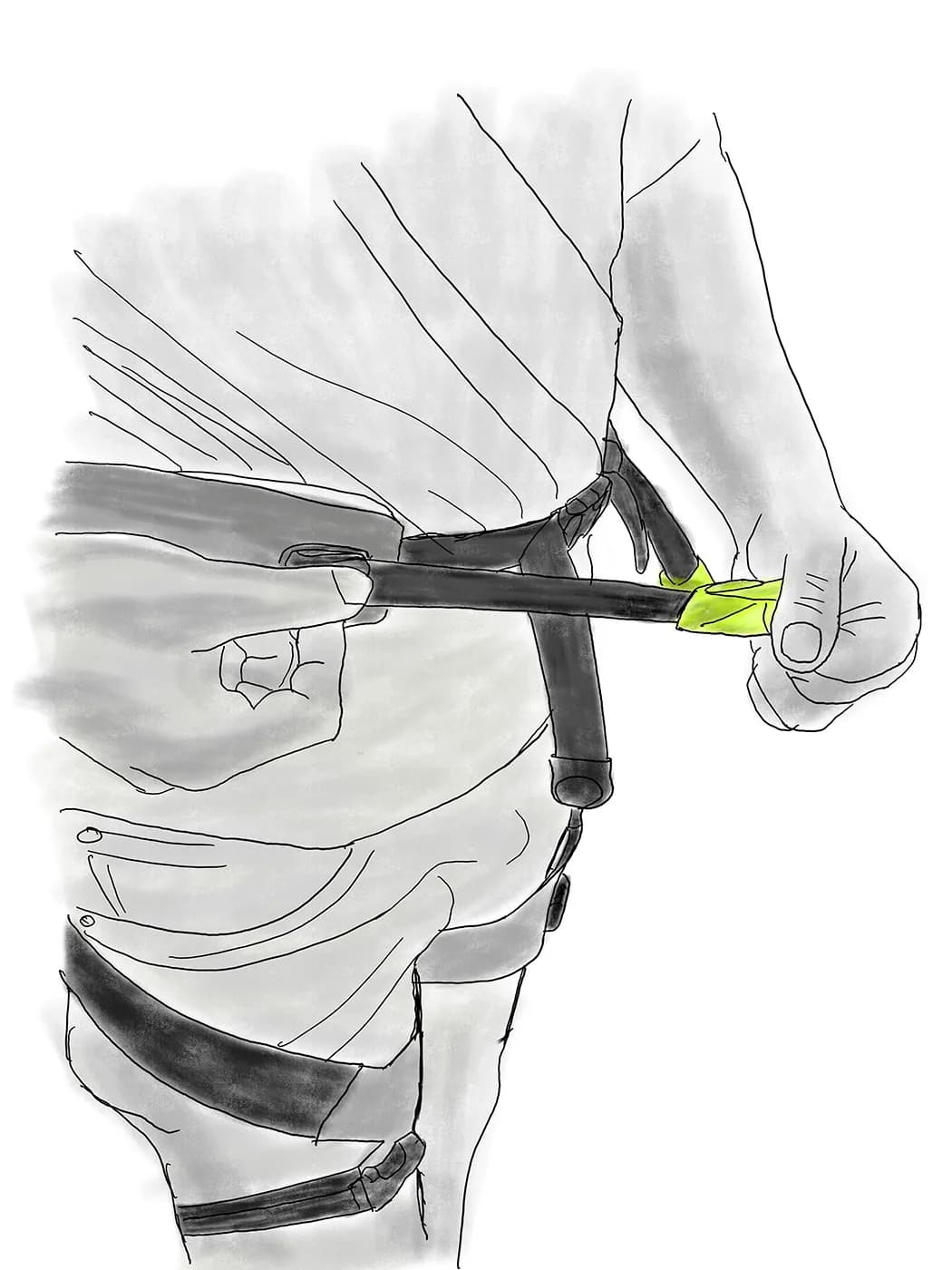 05
Set dynamic support on the right
Pull the coloured strap out of the right hip shell until the fabric over the buttocks rests lightly against the body, then close the buckle. Test it with several lifting movements.
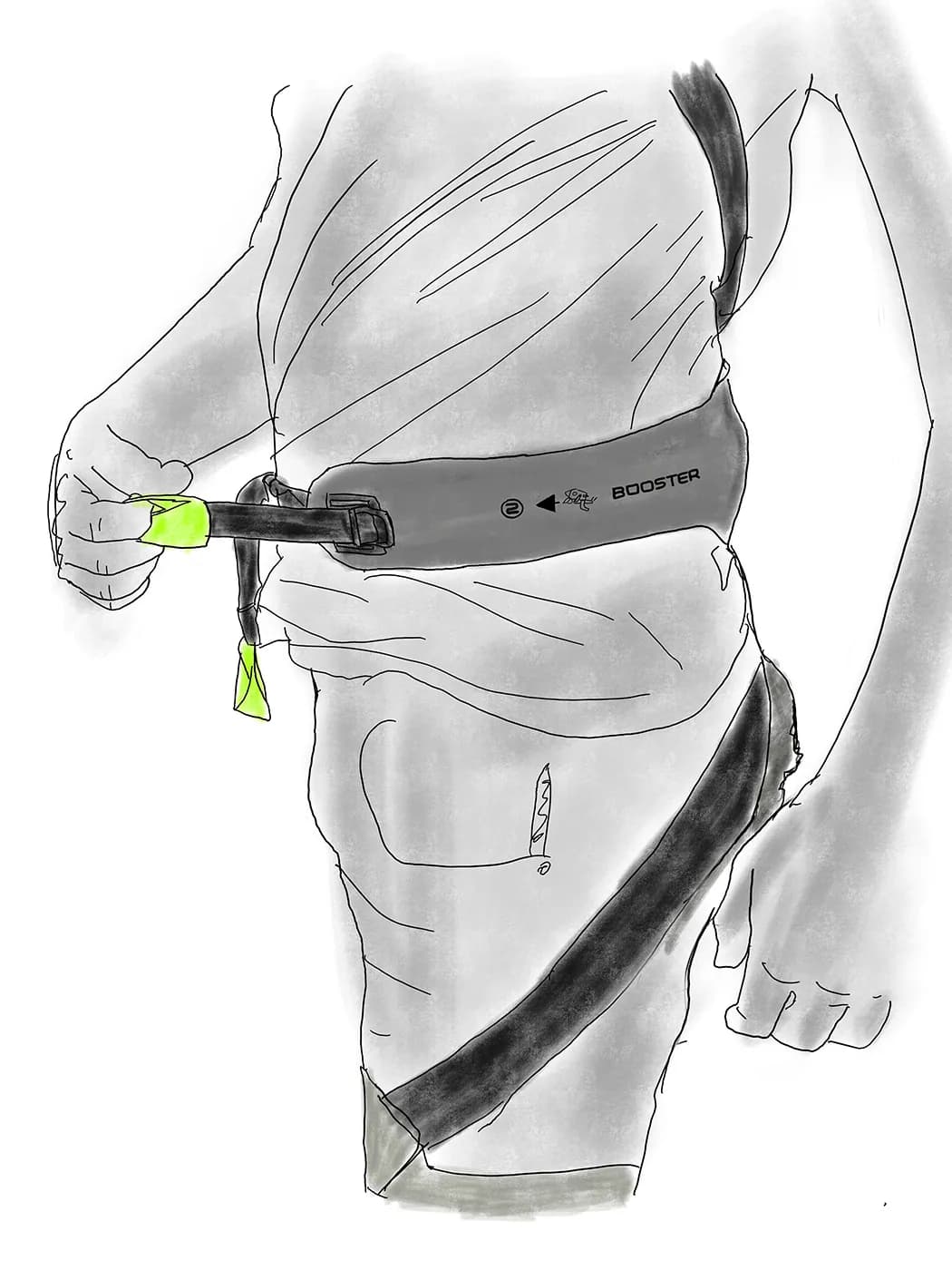 06
Add static support on the left if needed
For long bent-over work, pull the left strap as well. If it then stops deep bending or lifting from the floor, set it weaker or open its buckle.
- 07
Stow strap ends; take off in reverse
Tuck loose strap ends into the elastic loops. To take it off, open both hip buckles, bend slightly forward so the system lengthens, then loosen the straps and slip out.
04 · Specs
Specification and test figures
Build and sizes
- Type
- Passive back exoskeleton; no motor, battery or electronics
- Weight
- About 1,180 g (± 200 g by size, variant and accessories)
- Dimensions
- 55 × 37 × 33 cm
- Sizes
- XS: under 162 cm, M: 160–190 cm, XL: over 188 cm body height; unisex
- Materials
- Plastics PP, PE, PES, PA; stainless steel; textiles PES, natural rubber, PA 6.6, cotton
- In the box
- Exoskeleton, operating manual, extension set; chest strap depending on variant
- Made in
- Germany; development, production and assembly in Horb am Neckar
Support and wear
- Dynamic support
- Right-hand strap; continuously adjustable
- Static support
- Left-hand strap; engages from a set bending angle with damping
- Walking
- Freewheel function for normal walking and movement (maker's description)
- Wearing
- Put on and adjusted by the wearer; fits under a jacket; sitting is possible
- Pads
- 5 replaceable pads on Velcro; wash at 60 °C; no tumble drying, ironing, dry cleaning or bleach
Conditions, care and service
- Ambient temperature
- 0 °C to +40 °C
- Weather
- Indoors and outdoors; protect from heavy rain and prolonged direct sun
- Checks
- Visual check before each use; cleaning weekly or as needed; checklist every six months
- Wear parts
- Elastic elements may lose elasticity after about 1 million load cycles; UV, heat and ozone shorten their life
- Repairs
- Only by hTRIUS or a body it authorises
- Storage
- Hanging, dry, out of direct sunlight
Test figures (maker's figures)
- Muscle activity, ETH Zurich lab pilot
- Up to 24% lower on the maker's 2024 study page (5 people, 20 kg); its current page states up to 30%
- Back-muscle fatigue, same pilot
- Up to 86% lower
- Bent-over holding time, same pilot
- 55% longer on average
- Posture after a workday, Offenburg University with Zehnder
- 37% more upright on average (motion capture)
- Multifidus activity, University of Innsbruck (12 people, 13 kg box)
- −18.9% over the whole task, −22.3% when lifting from the floor (2023 paper); the maker cites −25%
Compliance, warranty and price
- EU conformity
- Declaration in the manual (10 Aug 2026, CE): Machinery Directive 2006/42/EC until 19 Jan 2027, Machinery Regulation (EU) 2023/1230 from 20 Jan 2027, EN ISO 12100:2010; Module A
- Seal
- AGR 'Geprüft & empfohlen' (Aktion Gesunder Rücken e.V.)
- Warranty
- Up to 3 years with the annual service, otherwise 12 months; wear parts excluded
- Price
- EUR 2,880 per unit on the maker's German pages (2026-10-11); ex works, plus VAT and packaging
05 · Cautions
Limits and warnings from the manual
Quoted from the English edition of the maker's operating manual (document version 3.0).
Our summary, then the maker's own words
Use it only for loads the wearer could lift without it; it is not meant to raise lifting capacity.
In the maker's words:
The BionicBack must not be used to lift loads that cannot be lifted without the BionicBack.
app-eu1.hubspotdocuments.comSwitch off both dynamic and static support before climbing ladders, scaffold stairs or similar; otherwise balance suffers and the risk of falling rises.
In the maker's words:
Before climbing, both dynamic and static support (if present) must be deactivated.
app-eu1.hubspotdocuments.comIt is not fall protection: it cannot replace a full-body harness, must not be used as a climbing harness, and no one may be lifted or secured by it. The maker lists the standard model as not compatible with fall protection.
In the maker's words:
The BionicBack is not a fall arrest system and must not be used in place of a full-body harness.
app-eu1.hubspotdocuments.comPermitted only at ambient temperatures from 0 °C to +40 °C.
In the maker's words:
The BionicBack may only be used in ambient temperatures from 0 °C to +40 °C.
app-eu1.hubspotdocuments.comUsable indoors and outdoors, but it must be kept out of heavy rain and long periods of direct sun.
In the maker's words:
It must be protected from heavy rain and prolonged direct sunlight.
app-eu1.hubspotdocuments.comNear exposed rotating or moving machine parts, stow every loose strap end in its elastic loop first, or straps and parts can be caught and pulled in.
In the maker's words:
Otherwise, protruding straps and parts may be caught or pulled along.
app-eu1.hubspotdocuments.comProtruding parts can catch on free-standing structures or other people, with a risk of falls and trapping.
In the maker's words:
Caution: risk of falling and entrapment.
app-eu1.hubspotdocuments.comHair can be drawn into the semi-open parts during movement; long hair must be tied back.
In the maker's words:
Long hair must be tied back accordingly.
app-eu1.hubspotdocuments.comIn high temperatures it increases sweating; regular cleaning and regular rest breaks are recommended.
In the maker's words:
In these circumstances, regular cleaning and regular rest breaks are recommended.
app-eu1.hubspotdocuments.comPeople with existing musculoskeletal conditions should consult a doctor before use; take it off if muscle or joint pain occurs.
In the maker's words:
Do not use the BionicBack if you have pre-existing musculoskeletal conditions without consulting a doctor.
app-eu1.hubspotdocuments.comCheck it visually before each use. If damage or a malfunction is found, stop using it until qualified staff or hTRIUS service has inspected and approved it.
In the maker's words:
If any damage or malfunction is detected, discontinue use immediately.
app-eu1.hubspotdocuments.comAll repairs and part replacements, including wear parts, are for hTRIUS or a body it authorises; users must not swap components.
In the maker's words:
Users must not replace any components themselves.
app-eu1.hubspotdocuments.com
06 · Videos
Maker videos: settings, site use and FAQ
Published by hTRIUS on YouTube, spoken in German; the English and Japanese titles are our translations.
Ready in seconds: the functions of the BionicBack exoskeleton
hTRIUS – Exoskelette made in Germany · 2:32 · German
Plays from YouTube once started. Open on YouTube
Exoskeleton on the construction site: how the BionicBack relieves the back
hTRIUS – Exoskelette made in Germany · 2:47 · German
Plays from YouTube once started. Open on YouTube
Exoskeletons simply explained: FAQ on the BionicBack
hTRIUS – Exoskelette made in Germany · 4:47 · German
Plays from YouTube once started. Open on YouTube
07 · FAQ
Questions the maker answers
Does it need power or charging?
No. It is a passive exoskeleton with no battery, motor or other electrical parts. It works mechanically, taking up the energy of the wearer's movement and redirecting it to relieve particular muscle groups.
From the maker's siteCan it be worn outdoors in rain, heat or cold?
The maker says it is built for strenuous work, copes with any weather its wearers can, and can go under a jacket, jumper or hi-vis vest; the pads are removable and washable. Its manual still limits use to 0–40 °C and asks for protection from heavy rain and long direct sun.
From the maker's siteWill the back muscles weaken if the exoskeleton does part of the work?
The maker argues that everyday work loads are not a useful training stimulus but a source of overload with little time to recover. The exoskeleton takes off the peak loads, while the muscles still do much of the work.
From the maker's siteWhere do the forces taken off the back go?
Every supporting force creates a counter-force somewhere in the body. The maker says the design aims to relieve the weak points and route the extra load to parts of the body that can carry it better.
From the maker's siteIs the relief felt straight away, and can a team try it first?
As with other protective equipment, some wearers adapt at once and others need a short familiarisation. The maker offers a bookable test package at the customer's site with a final report, and recommends starting with at least two units.
From the maker's site08 · Sheet
Side by side, on the same sheet.
Every product in the catalog is described with the same fields, in the same order, so you can compare them side by side. What it reduces and where it fits are at the top of this page.
- Key specs
- Passive back exoskeleton without motor or battery. A flexible plastic back structure follows the spine; elastic elements over the buttocks link the hip shells to thigh supports. Right strap: dynamic support, continuously adjustable; left strap: static support that engages from a set bending angle. About 1.18 kg (±200 g), 55 × 37 × 33 cm, sizes XS, M and XL by body height, unisex. Five replaceable pads, washable at 60 °C. For use at 0–40 °C. Up to 30% lower muscle activity (maker's figure, lab pilot). Made in Germany.
- Price conditions
- Not published for Japan. The maker's German pages list the BionicBack at EUR 2,880 per unit (2026-10-11); its terms for business customers say prices are ex works, excluding packaging and plus VAT.
- Trial
- The maker offers a bookable test package at the customer's site. Its rental terms credit the rental fee (up to EUR 500 per unit) against the EUR 2,880 price if the unit is bought within 6 weeks. Availability outside Germany is not stated.
- Lead time
- Not in public info
- Service and repair
- Up to 3 years' warranty from purchase if the annual service interval is kept, otherwise 12 months; wear and consumable parts excluded; repairs and part replacement only by hTRIUS or a body it authorises (maker's manual). Its terms for business customers set a 12-month limit for defect claims.
- Local partner
- Not in public info
- StandardsMaker's declaration
- EU declaration of conformity in the manual (dated 10 Aug 2026, with CE mark): Machinery Directive 2006/42/EC until 19 Jan 2027, Machinery Regulation (EU) 2023/1230 from 20 Jan 2027, EN ISO 12100:2010; self-assessed under internal production control (Module A). AGR seal 'Geprüft & empfohlen' from Aktion Gesunder Rücken e.V., a back-health product seal rather than a safety certification.
09 · Documents
Documents and links.
Official files and pages from hTRIUS. Each opens on the maker's site.
- Operating manual, BionicBack family (v3.0, 15 languages, with EU declaration of conformity)User manual · Several languages · PDF
- How to use the BionicBack: fitting guideWeb page · English · htrius.com
- User support page: donning videos, accessories and manualWeb page · German · htrius.com
- Studies page: test results and FAQWeb page · English · htrius.com
- AGR seal of approval (maker's page)Web page · English · htrius.com
- AGR list of certified exoskeletonsWeb page · English · agr-ev.de
- General terms and rental termsWeb page · English · htrius.com
- University of Innsbruck comparison of five back exoskeletons (2023 paper)Web page · English · doi.org
10 · Maker
hTRIUS
Germany
hTRIUS GmbH develops and builds passive exoskeletons in Horb am Neckar, south-west Germany. Founded in 2020, it makes the BionicBack family (BionicBack, BionicBack MOVE and BionicBack FP READY) and in November 2025 opened a site of about 1,500 m² for development, production, assembly and a showroom.
- Founded
- 2020
- Headquarters
- Horb am Neckar, Baden-Württemberg, Germany
- Website
- htrius.com
Sources34
Read on . Each date below is the version we read: an archived copy's capture date, or a document's own date.
- hTRIUS – BionicBack product page (English)htrius.com ·
- hTRIUS – BionicBack product page (German)htrius.com ·
- hTRIUS – Bedienungsanleitung / Operating Manual BionicBack, document version 3.0 (PDF, created 2026-08-18)app-eu1.hubspotdocuments.com ·
- hTRIUS – BB How to Use (English)htrius.com ·
- hTRIUS – BB How to Use (German)htrius.com ·
- hTRIUS – user support page (www.htrius.com/quickstart redirects here)htrius.com ·
- hTRIUS – Studies page with FAQ (English)htrius.com ·
- hTRIUS – Studies page (German)htrius.com ·
- hTRIUS – older study page 'Wissen ALT' (unlisted, still online)htrius.com ·
- Internet Archive – hTRIUS Wissen page, October 2024htrius.com · Web archive ·
- hTRIUS – AGR seal page (English)htrius.com ·
- Aktion Gesunder Rücken – certified exoskeletonsagr-ev.de ·
- Aktion Gesunder Rücken – about the AGR sealagr-ev.de ·
- hTRIUS – BionicBack MOVE page with comparison table and size FAQhtrius.com ·
- hTRIUS – BionicBack FP READY page with comparison tablehtrius.com ·
- hTRIUS – accessories pagehtrius.com ·
- hTRIUS shop – Polster Wechselset BionicBack (pad set, care label)htrius.com ·
- hTRIUS – logistics landing page with unit pricehtrius.com ·
- hTRIUS – general terms and rental terms (English)htrius.com ·
- hTRIUS – AGB (German)htrius.com ·
- hTRIUS – request and test options pagehtrius.com ·
- hTRIUS – fields of applicationhtrius.com ·
- hTRIUS – occupational safety page (freewheel function)htrius.com ·
- hTRIUS – industry pages: construction, logistics, landscaping, tilinghtrius.com ·
- hTRIUS – About ushtrius.com ·
- hTRIUS – Impressum (legal notice)htrius.com ·
- hTRIUS – press release: new site in Horb am Neckar (27 Nov 2025)htrius.com ·
- hTRIUS – press kit KfW Award 2025 (ZIP; reprint terms)2743fd3c-2419-4f04-b0db-bf51f12a54d1.usrfiles.com ·
- hTRIUS – YouTube channelyoutube.com ·
- YouTube – In wenigen Sekunden einsatzbereit | Die Funktionen des BionicBack-Exoskelettsyoutube.com ·
- YouTube – Exoskelett auf der Baustelle: So entlastet das BionicBack den Rückenyoutube.com ·
- YouTube – Exoskelett einfach erklärt – FAQ zum BionicBackyoutube.com ·
- YouTube – Wissenschaft trifft Innovation: Das BionicBack Exoskelett (ETH figures in description)youtube.com ·
- Reimeir et al. (2023), Wearable Technologies 4, e12 – Effects of back-support exoskeletons with different functional mechanismsdoi.org ·
We wrote this page from hTRIUS's public website and documents as of . hTRIUS has not confirmed anything on it and is not involved with this site. Photos and videos are hTRIUS's own, each linked to where it appears. Items the maker does not publish are marked “Not in public info”. Standards are the maker's declarations; we do not judge compliance.
Other products on the same sheet

Custom Fit Kneepads
ProKnee · United States
Full-length kneepads that move kneeling weight onto the shins, sized to each worker's leg measurements.

Hapo BACK
ErgoSanté · France
Spring-rod back exoskeleton for forward bending, 1.1 kg and battery-free, with a release for sitting down.

SoftExo Lift
HUNIC · Germany
Passive textile exoskeleton: leg elastomers store energy as you bend and give it back as you straighten up.