
BAND V2
SlateSafety · United States
Upper-arm band that estimates core temperature from heart rate and movement, and alerts wearer and supervisor.

BAND V2 is an 82 g armband worn against the skin of the upper arm. From its optical heart-rate and motion sensors it derives heart rate, an estimate of core body temperature, exertion and heart-rate limit value; when an employer-set limit is passed, it vibrates and lights up, and supervisors are notified over its built-in cellular link or a SlateSafety gateway. SOS tap, no-movement and fall alerts cover lone work.
- Weight with strap
- 82 g
- Per charge, by settings (maker)
- 24–100 h
- Dust and water rating
- IP68
- Operating temperature
- −20 to +55 °C
- Written from
- slatesafety.com
- Information as of
- Local partner
- Not in public info
At a glance
Reduces
Heat strain and overexertion that build up unnoticed during physically demanding work
Suitable for
Physically demanding work in heat or under heavy PPE, including fully encapsulated protective suits; the maker names manufacturing, construction, utilities, environmental remediation, first response and military training. Also lone work and confined-space entry. Worn on the upper arm under standard PPE.
Not suitable for
Areas where an explosive atmosphere may occur: the maker warns that charging or using the band there may be hazardous, and lists its intrinsic-safety (Class 1, Division 1) certification as coming soon (2026-10-11). Not intended for uses where a device failure could lead to death, injury or severe environmental damage. High concentrations of industrial chemicals, such as evaporating liquefied gases, may damage it. Operating range −20 to +55 °C.
The maker's warnings (14)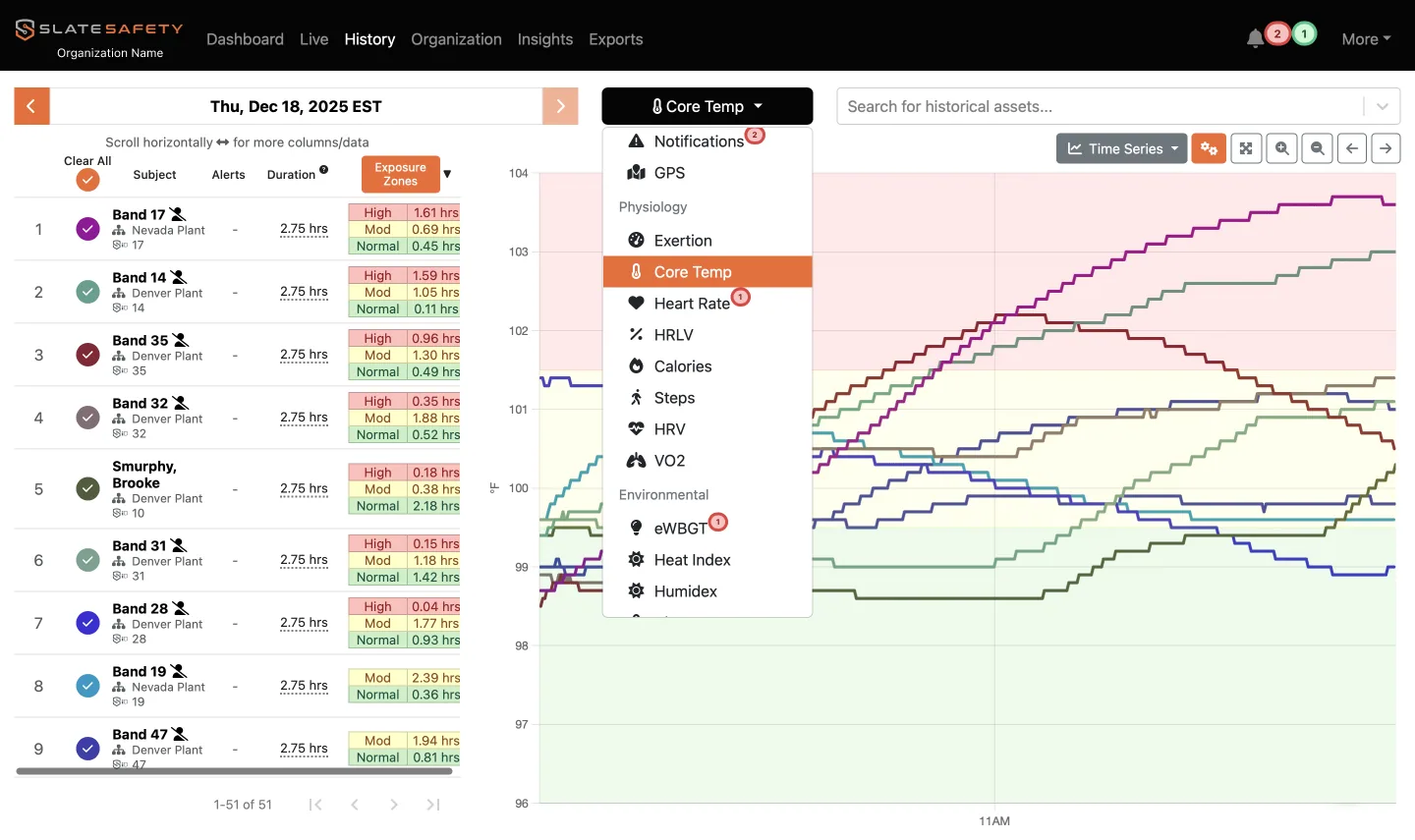
01 · Core temp
Core temperature is estimated from heart rate and movement
The band does not measure core temperature at the arm. SlateSafety says it estimates it from the motion sensor and a sequence of heart-rate readings, using methods of the kind US Army researchers have applied; its support article links a 2013 study that estimated core temperature from sequential heart rate. Because each estimate builds on earlier readings, the maker says it can take up to 15 minutes to settle after the band goes on. The same signals give exertion, a 0–100 % score based on the Physiological Strain Index, and heart-rate limit value (HRLV), which compares current heart rate with an age-based sustainable maximum.
- The maker's summary of three third-party studies in lab and training settings (35 people, 2,067 minutes) gives a mean absolute error of 0.25 °C against ingestible-pill or rectal thermometers (maker's figure).
- SlateSafety says the algorithm tends to read slightly high (mean bias 0.07 °C) and describes this as deliberate, to stay on the safe side.
- Everything depends on steady skin contact: a loose strap, tattoos or a band that has slipped weaken the heart-rate signal, and the software then shows the data in grey.
- Age, height, weight and sex can be entered for each worker; without them the band uses default values, and the maker warns that HRLV will then likely be inaccurate.
02 · Alerts
Limits, signals on the arm and who gets told
Each band follows a loadout: the limits and features an admin sets for a group of workers in the web app.
Your own limits or the ACGIH preset
An alert fires when heart rate, estimated core temperature, exertion or HRLV stays above a limit for a set time, tagged low or high severity. A preset applies ACGIH's 2022 heat-stress values; the maker recommends no specific limits.
Signals on the arm
By default, 3 pulses with yellow light mean a low-severity alert, 4 pulses with red a high-severity alert, and 2 pulses with green that the wearer may return to work. Pulse counts can be set from 1 to 7 or turned off.
Supervisors by text, email, call or WhatsApp
Alert contacts can be filtered by severity, group or band and given schedules. A supervisor can accept an alert and add a note, stored with their name and the time as a record of the response.
SOS tap, no movement and falls
A double tap on the face held for 3 seconds sends an SOS, even through a sleeve. A no-movement alert follows a set idle time, with warning pulses 30 and 10 seconds before. Fall detection is labelled experimental.
Privacy modes for physiological data
Alerts Only Mode sends alerts but keeps physiological data off the cloud; Physiology Disabled Mode collects none. Bands can also run unassigned and anonymous, on a default profile.
Live view, history and reports
The web app shows live cards coloured by exertion, history charts, a summary of heat-stress events and response times, CSV or XLSX exports and scheduled email reports. The SlateSafety Go app runs on iOS and Android; menus are in English.
03 · Connectivity
Four ways a band gets its data out
Remote alerts need a route to SlateSafety's cloud. Without one, the band still alerts the wearer and keeps recording.
Cellular coverage
- How data travels
- Built-in LTE-M/NB-IoT modem straight to the cloud, with no setup
- Range and notes
- The maker lists Japan with NTT Docomo and SoftBank (support page updated 17 August 2026) and advises testing coverage on site
- Who is alerted
- Wearer and remote contacts
No cellular, but Wi-Fi or Ethernet on site
- How data travels
- Bluetooth LE (2.4 GHz) to a GATEWAY V2, which uses the site network (2.4 GHz Wi-Fi or Ethernet)
- Range and notes
- About 400 m in typical settings and 800 m line of sight in theory (maker's figures); satellite gateway options are also listed
- Who is alerted
- Wearer and remote contacts
A smartphone nearby
- How data travels
- Band Link: one assigned band uses the phone's internet. Local Mode: the app shows nearby bands with no internet
- Range and notes
- Local Mode reaches about 60 m in typical settings (maker's figure)
- Who is alerted
- Wearer and the supervisor with the phone; remote contacts only through Band Link
No signal at all
- How data travels
- Data stays on the band (32 MB, over 300 hours) and uploads when a route returns
- Range and notes
- Alerts on the arm still work
- Who is alerted
- Wearer only
The Japanese network listing is the maker's statement. SlateSafety describes a 24-hour test in which charging bands log signal strength at chosen spots, after which its support team sends a coverage report.
04 · Videos
Maker videos: the band, the strap, SOS tap and software
Short clips from SlateSafety's channel, all in English.
The SlateSafety BAND V2
SlateSafety · 1:20 · English
Plays from YouTube once started. Open on YouTube
SlateSafety BAND V2: How to Attach Adjustable Strap
SlateSafety · 0:52 · English
Plays from YouTube once started. Open on YouTube
SlateSafety How To: Tap Alerts
SlateSafety · 0:23 · English
Plays from YouTube once started. Open on YouTube
SlateSafety Quick Software Demo
SlateSafety · 2:19 · English
Plays from YouTube once started. Open on YouTube
05 · Specs
BAND V2 specifications
From the user manual (Rev J, October 2025), the product page and the 2025 overview sheet; performance figures are the maker's.
Device
- Dimensions
- 68.6 × 71.1 × 13.5 mm
- Weight
- 82 g with strap
- Housing and rating
- High-impact polycarbonate; IP68, dust-proof, submersible to 150 ft (about 45 m)
- Strap
- Polyester and nylon hook-and-loop with latex-containing elastic; a latex-free fire-retardant Nomex strap is available
- Processor and memory
- Arm Cortex-M33; 32 MB, over 300 hours offline
Sensing and feedback
- Sensors
- Optical (PPG) heart-rate sensor, 6-axis motion sensor (IMU), on-body detection
- Metrics
- Heart rate, estimated core temperature, exertion, HRLV; estimated VO2, HRV, calories and steps in the software
- Calibration
- Not needed for the PPG heart-rate sensor, according to the maker
- Feedback
- High-G vibration motor and four RGB LEDs
Connectivity
- Cellular
- LTE-M / NB-IoT, subject to regional support
- Local radio
- Bluetooth LE 5.3 (2.4 GHz) to a GATEWAY V2 or a phone
- Location
- GPS (L1), can be switched off; coarse indoor location with optional BEACON V2 units
- Security and updates
- End-to-end encryption and Arm TrustZone; firmware updates over the air while charging
Power and environment
- Battery
- 700 mAh lithium-ion polymer, 2.59 Wh
- Runtime
- 24–100 h per charge depending on configuration; no breakdown by mode is published
- Charging
- Magnetic single charger in the box or 5-bay MULTI-CHARGER V2; blue light charging, magenta full; 3–4 h per the maker's training slides
- Charger adapter
- 100–240 V AC, 50/60 Hz in; 6.1 V DC, 1 A out; 4 ft cable
- Operating conditions
- −20 to +55 °C, 5–95 % RH non-condensing, up to 5 km altitude, wet locations permitted
- Storage and charging
- 0 to +45 °C
Software and purchase
- Software
- Web app in Chrome, Edge or Firefox; SlateSafety Go for iOS 17 or Android 13 and later; interface in English
- Hosting
- SlateSafety's cloud only; no on-premise installation
- How it is sold
- Hardware from SlateSafety or an authorised reseller plus a platform subscription; 12-month terms that renew yearly, fees in US dollars unless the order says otherwise (maker's terms). Prices are not published
- Data and integrations
- CSV or XLSX export; API for third-party systems
06 · Cautions
The maker's warnings and conditions of use
Our summary, then the maker's own words
Core temperature is an estimate built from successive heart-rate and motion readings, and it can take up to 15 minutes to settle after the band goes on.
In the maker's words:
Because core body temperature estimates are derived from accelerometry and sequential heart rate readings, it may take up to 15 minutes for core body temperature estimates to baseline.
support.slatesafety.comIt is not a medical device and does not replace medical judgement.
In the maker's words:
BAND V2 is not a medical device and should not be used as a substitute for professional medical judgment.
support.slatesafety.comThe employer chooses the alert and return-to-work limits; the maker does not guarantee that any set of limits is effective.
In the maker's words:
SlateSafety cannot guarantee the effectiveness of Physiological Alert or Return-To-Work thresholds.
support.slatesafety.comCharging or using it where an explosive atmosphere may occur can be hazardous; intrinsic-safety certification is still listed as coming soon.
In the maker's words:
Charging or using BAND V2 in any area with a potentially explosive atmosphere, such as areas where the air contains high levels of flammable chemicals, vapors, or particles (such as grain, dust, or metal powders), may be hazardous.
support.slatesafety.comHigh concentrations of industrial chemicals, including evaporating liquefied gases such as helium, may damage the band.
In the maker's words:
Exposing BAND V2 to environments having high concentrations of industrial chemicals, including near evaporating liquified gasses such as helium, may damage or impair BAND V2 functionality.
support.slatesafety.comNot intended for uses where a failure of the band could lead to death, injury or severe environmental damage.
In the maker's words:
BAND V2 is not intended for use where the failure of the device could lead to death, personal injury, or severe environmental damage.
support.slatesafety.comRemote supervisors are notified only while the band can reach the cloud by cellular or a gateway (or a phone through Band Link).
In the maker's words:
If the BAND V2 has connection to the cloud either via cellular network or GATEWAY V2, then Alert Contacts specified on the Organization page can also receive a notification via email, text message, phone call, or WhatsApp.
support.slatesafety.comCellular coverage varies by carrier and site, so the maker advises testing it where the bands will be used.
In the maker's words:
Please note it is best to test the system in your area as the coverage may vary depending on several factors from the cellular network provider.
support.slatesafety.comThe sensor must touch bare skin; the band does not work over clothing.
In the maker's words:
The BAND will not work when worn over clothing.
support.slatesafety.comThe standard strap contains latex; wearers with a latex allergy should use the latex-free fire-retardant strap.
In the maker's words:
The Strap V2 is made out of elastic containing latex. Users with a known latex allergy are advised to use the Fire Retardant Strap instead which does not contain any Latex
support.slatesafety.comMagnets and radios in the band and chargers may interfere with pacemakers and other medical devices; keep them more than 15 cm away and ask the physician and device maker.
In the maker's words:
keep each BAND V2, and BAND V2 single, and multi-charger accessories a safe distance away from any medical device (greater than 6 inches/15 cm, but consult with a physician and the device manufacturer for specific guidelines).
support.slatesafety.comFall detection is experimental and can raise false alerts.
In the maker's words:
The Fall Detection Alert feature is labeled "Experimental" because it can lead to false positive alerts.
support.slatesafety.comCharge only with SlateSafety's chargers and adapters; other adapters may not meet safety standards.
In the maker's words:
Other adapters may not meet applicable safety standards, and charging with such adapters could pose a risk of death or injury.
support.slatesafety.comClean with mild dish soap and water or isopropyl alcohol wipes; products with ethanol, chloride or acetone must not be used on the housing.
In the maker's words:
Products containing ethanol, chloride or acetone should also not be used.
support.slatesafety.com
07 · FAQ
Questions answered in SlateSafety's support pages
Where and how should the band be worn?
On the upper arm, usually above the triceps and below the shoulder, with the sensor flat on bare skin and away from tattoos or dips in the muscle. Either arm and either way up works. A loose strap can lose the heart-rate signal, but it should not be over-tight; worn correctly, the band responds with a vibration and an orange light.
From the maker's siteCan the band connect over cellular networks in Japan?
SlateSafety's list of countries where the band can connect directly over cellular includes Japan, with NTT Docomo and SoftBank named as networks. Elsewhere, or where coverage is weak, it connects through a GATEWAY V2 on Wi-Fi or Ethernet, or through a phone with Band Link. The maker recommends testing coverage locally.
From the maker's siteDoes the heart-rate sensor need calibrating like a gas detector?
No, according to the maker. The optical sensor looks only for periodic changes in blood volume, so drift in its offset or sensitivity does not change the heart rate it finds. Gas sensors, by contrast, measure an absolute concentration and need regular recalibration as they age.
From the maker's siteHow should bands be cleaned between wearers?
Unassign the band, remove the strap, then scrub the band in water with mild dish soap, rinse and towel it dry, or wipe it with an isopropyl alcohol wipe. The maker recommends sanitising whenever a band goes to a new user. Straps can be machine-washed on a hot cycle with an extra rinse.
From the maker's siteHow should bands be stored outside the hot season?
For storage longer than three months, charge each band fully and keep it off the charger in a dry, climate-controlled room. Put bands back on charge from time to time somewhere with good coverage so they pick up firmware updates, and allow time for updates before the next season.
From the maker's siteCan the software be installed on our own servers?
No. SlateSafety offers its cloud service only. It explains that remote diagnostics, firmware updates, real-time text and email alerts, the mobile app and its backups (full weekly, incremental daily) all depend on that cloud.
From the maker's site08 · Sheet
Side by side, on the same sheet.
Every product in the catalog is described with the same fields, in the same order, so you can compare them side by side. What it reduces and where it fits are at the top of this page.
- Key specs
- Upper-arm band, 82 g with strap, 68.6 × 71.1 × 13.5 mm. An optical heart-rate sensor and a 6-axis motion sensor give heart rate and an estimate of core body temperature derived from heart rate and movement (it can take up to 15 minutes to settle), plus exertion and heart-rate limit value. Alerts the wearer by vibration and LEDs and supervisors by email, text, phone call or WhatsApp; SOS tap, no-movement and fall alerts; GPS. Built-in LTE-M/NB-IoT and Bluetooth LE (2.4 GHz) to a gateway or phone. 24–100 h per charge. IP68, submersible to 150 ft (about 45 m).
- Price conditions
- Not in public info
- Trial
- Not in public info
- Lead time
- Not in public info
- Service and repair
- 1-year limited hardware warranty from the date of shipment (maker's terms, updated 2026-07-15). The terms are written for US and Canadian customers and apply elsewhere only as far as local law allows; a claim needs an active SlateSafety subscription, and the buyer pays shipping to SlateSafety. Only SlateSafety services the battery. Support by email (support@slatesafety.com).
- Local partner
- Not in public info
- StandardsMaker's declaration
- FCC (FCC ID 2A357002) and CE marking, as declared by the maker; the manual also carries Canada's ISED licence-exempt notice, and the battery is listed as UL 1642 certified. No declaration of conformity was found on the maker's site. Intrinsic safety (Class 1, Division 1) is not certified yet: the maker lists it as coming soon (2026-10-11). The cloud service holds SOC 2 Type 2 (maker's statement).
09 · Documents
Documents and links.
Official files and pages from SlateSafety. Each opens on the maker's site.
- BAND V2 user manual (Rev J, October 2025)User manual · English · PDF
- BAND V2 overview and specifications (2025)Datasheet · English · PDF
- Quick start guide for wearers (2025)Guide · English · PDF
- Quick start guide for wearers, Japanese machine translationGuide · Japanese · PDF
- Heat Science: summary of third-party core temperature studies (August 2023)Document · English · PDF
- GATEWAY V2 user manual (Rev B)User manual · English · PDF
- Important safety information for BAND V2Web page · English · support.slatesafety.com
- Limited hardware warrantyWeb page · English · slatesafety.com
10 · Maker
SlateSafety
United States
SlateSafety is the trading name of FireHUD, Inc., an Atlanta company founded in 2016 that began with a heads-up display for firefighters and took the SlateSafety name in October 2021. It now makes the BAND V2 armband, BEACON environmental monitors and the cloud software that links them, and publishes case studies from US Department of Energy cleanup sites, military training and fire services.
- Founded
- 2016
- Headquarters
- Atlanta, Georgia, United States
- Website
- slatesafety.com
Sources79
Read on . Each date below is the version we read: an archived copy's capture date, or a document's own date.
- SlateSafety: BAND V2 product pageslatesafety.com ·
- BAND V2 User Manual Rev J (PDF)slatesafety.com ·
- BAND V2 2025 overview and specifications (PDF)slatesafety.com ·
- SlateSafety User Quick Start Guide 2025 (PDF)slatesafety.com ·
- SlateSafety User Quick Start Guide 2025, Japanese, marked 'Machine Translated by Google' (PDF)slatesafety.com ·
- SlateSafety Heat Science: third-party validation studies (PDF)slatesafety.com ·
- SlateSafety BAND V2 Platform Training Slides (PDF)slatesafety.com ·
- GATEWAY V2 User Manual Rev B (PDF)slatesafety.com ·
- MULTI-CHARGER V2 user manual (PDF)slatesafety.com ·
- Support: How is core body temperature collected?support.slatesafety.com ·
- Support: What BAND V2 wearers should knowsupport.slatesafety.com ·
- Support: Important Safety Information for BAND V2support.slatesafety.com ·
- Support: How to wear a SlateSafety BANDsupport.slatesafety.com ·
- Support: Everything you need to know about Alert and Return-To-Work Notificationssupport.slatesafety.com ·
- Support: How do I use the ACGIH guidelines?support.slatesafety.com ·
- Support: What is exertion?support.slatesafety.com ·
- Support: What is HRLV?support.slatesafety.com ·
- Support: How are height, weight, age, and sex usedsupport.slatesafety.com ·
- Support: Why is my data grayed out?support.slatesafety.com ·
- Support: What is a Tap Alert?support.slatesafety.com ·
- Support: What is a No Movement Alert?support.slatesafety.com ·
- Support: BAND V2 Fall Detectionsupport.slatesafety.com ·
- Support: What are Sustained Alerts?support.slatesafety.com ·
- Support: Setting Up Alert Contactssupport.slatesafety.com ·
- Support: How to accept a notificationsupport.slatesafety.com ·
- Support: Alerts Only Modesupport.slatesafety.com ·
- Support: Physiology Disabled Modesupport.slatesafety.com ·
- Support: What are Anonymous BANDs?support.slatesafety.com ·
- Support: BAND V2 Low Battery Notificationssupport.slatesafety.com ·
- Support: BAND V2 Hardware Errorssupport.slatesafety.com ·
- Support: BAND V2 Statessupport.slatesafety.com ·
- Support: Which countries can use SlateSafety?support.slatesafety.com ·
- Support: How to Use GATEWAY V2ssupport.slatesafety.com ·
- Support: What is Band Link?support.slatesafety.com ·
- Support: SlateSafety Go Local Modesupport.slatesafety.com ·
- Support: Testing Cellular Signal Strengthsupport.slatesafety.com ·
- Support: Why am I not seeing data?support.slatesafety.com ·
- Support: PPG Heart Rate Sensing and Calibrationsupport.slatesafety.com ·
- Support: How to Clean BAND V2ssupport.slatesafety.com ·
- Support: BAND V2 Storagesupport.slatesafety.com ·
- Support: How do I update my BAND V2's firmware version?support.slatesafety.com ·
- Support: Why we do not offer on-premise deploymentssupport.slatesafety.com ·
- Support: SlateSafety App Requirementssupport.slatesafety.com ·
- Support: How to Auto Translate SlateSafetysupport.slatesafety.com ·
- Support: Insights Page FAQsupport.slatesafety.com ·
- Support: How to receive automated reports of SlateSafety datasupport.slatesafety.com ·
- Support: How to Use Assigner Kiosksupport.slatesafety.com ·
- Support: Useful Links and Documentssupport.slatesafety.com ·
- Support: Training Documentationsupport.slatesafety.com ·
- SlateSafety: Software V2slatesafety.com ·
- SlateSafety: Accessoriesslatesafety.com ·
- SlateSafety: Starter Kit V2slatesafety.com ·
- SlateSafety: Intrinsically Safe Solutionsslatesafety.com ·
- SlateSafety: Heat Illness Preventionslatesafety.com ·
- SlateSafety: Lone Worker Safetyslatesafety.com ·
- SlateSafety: Confined Space Safetyslatesafety.com ·
- SlateSafety: Security & Privacyslatesafety.com ·
- SlateSafety: Limited Hardware Warrantyslatesafety.com ·
- SlateSafety: Terms of Serviceslatesafety.com ·
- SlateSafety: About Usslatesafety.com ·
- SlateSafety: FireHUD Strategically Rebrands as SlateSafetyslatesafety.com ·
- Buller et al., Estimation of human core temperature from sequential heart rate observations, Physiological Measurement 34:781 (paper linked from support article 55; title checked via Crossref)iopscience.iop.org ·
- SlateSafety: From the Desk of the CEO: SlateSafety in 2026slatesafety.com ·
- SlateSafety: From the Desk of the CEO: 2025 Visionslatesafety.com ·
- SlateSafety: Heat Science: Third-Party Validation of SlateSafety Core Temperature Monitoringslatesafety.com ·
- SlateSafety: Core Temperature Validation Study with the University of Alabamaslatesafety.com ·
- SlateSafety: BAND V2 Rated Best Physiological Monitoring System (SAVER summary)slatesafety.com ·
- SlateSafety: Pacific Data Systems Australia partnershipslatesafety.com ·
- SlateSafety: SlateSafety Wins 2023 Industrial Hygiene Award (image page)slatesafety.com ·
- SlateSafety: PPG Sensors blog post (image page)slatesafety.com ·
- SlateSafety: Prepare Now, Stay Cool Later (image page)slatesafety.com ·
- SlateSafety: OH&S 2023 Product of the Year (image page)slatesafety.com ·
- SlateSafety: Moving from Reactive to Predictive Heat Safety (image page)slatesafety.com ·
- YouTube: The SlateSafety BAND V2youtube.com ·
- YouTube: SlateSafety BAND V2: How to Attach Adjustable Strapyoutube.com ·
- YouTube: SlateSafety How To: Tap Alertsyoutube.com ·
- YouTube: SlateSafety Quick Software Demoyoutube.com ·
- App Store (Japan): SlateSafety Go, version 5.1.2apps.apple.com ·
- Internet Archive: BAND V2 product page, 15 June 2025 captureslatesafety.com · Web archive ·
We wrote this page from SlateSafety's public website and documents as of . SlateSafety has not confirmed anything on it and is not involved with this site. Photos and videos are SlateSafety's own, each linked to where it appears. Items the maker does not publish are marked “Not in public info”. Standards are the maker's declarations; we do not judge compliance.
Other products on the same sheet

Adjustable Zipper Cooling Vest
Polar Products · United States
A zip-front cooling vest sized with hook-and-loop straps, holding 5–12 frozen or phase-change packs.

Cooling Vest
Arctic Heat · Australia
A light vest with gel pockets that you soak, freeze and wear to cool the chest and upper back in hot work.

StaCool Industrial Vest
StaCool Vest · United States
A one-size Cordura vest that cools the torso with six frozen gel packs, for hot work and wear under PPE.